
When Dad cuts down the chestnut tree,
 He'll make such things for you and me...
  A rocking horse to ride all day
   A fort where all my soldiers stay.
    A wheelbarrow painted blue,
     A faithful duck on wheels for you.
      Stilts to make us very tall,
       Colored blocks to build a wall.
        When the tree is on the ground,
         All my friends will come around.
          On the trunk we'll jump and climb,
           We will have a lovely time!
            No more tearing jacket sleeves,
             No more sweeping up of leaves.
              And when I'm tucked into my bed,
               Kisses kissed and goodnights said,
                The tree won't scare me any more,
                 When the night wind makes it roar.
If there wasn't any tree
What difference would it make to me?
                  No tree house - that's the worst of all -
                 To hide in when we hear Mom call.
                No cool places in the shade,
               When we have run and jumped and played.
              No leaves to kick and throw about
             And roll each other in and shout.
            No sticks to find on chilly days,
           To make our winter fires blaze.
          And there is another thing -
         What will happen to our swing?
        Where will owl and squirrel stay
       If the tree is hauled away?
      If the tree is really gone,
     What can I hang my birdhouse on?
    Suddenly we're not so sure
   We want it cut down any more.
  Trees are special, large or small,
 So Dad - don't cut it down at all!
 (When Dad Cuts Down the Chestnut Tree by Pam Ayres, illus by Graham Percy; Walker Books, London, 1988)
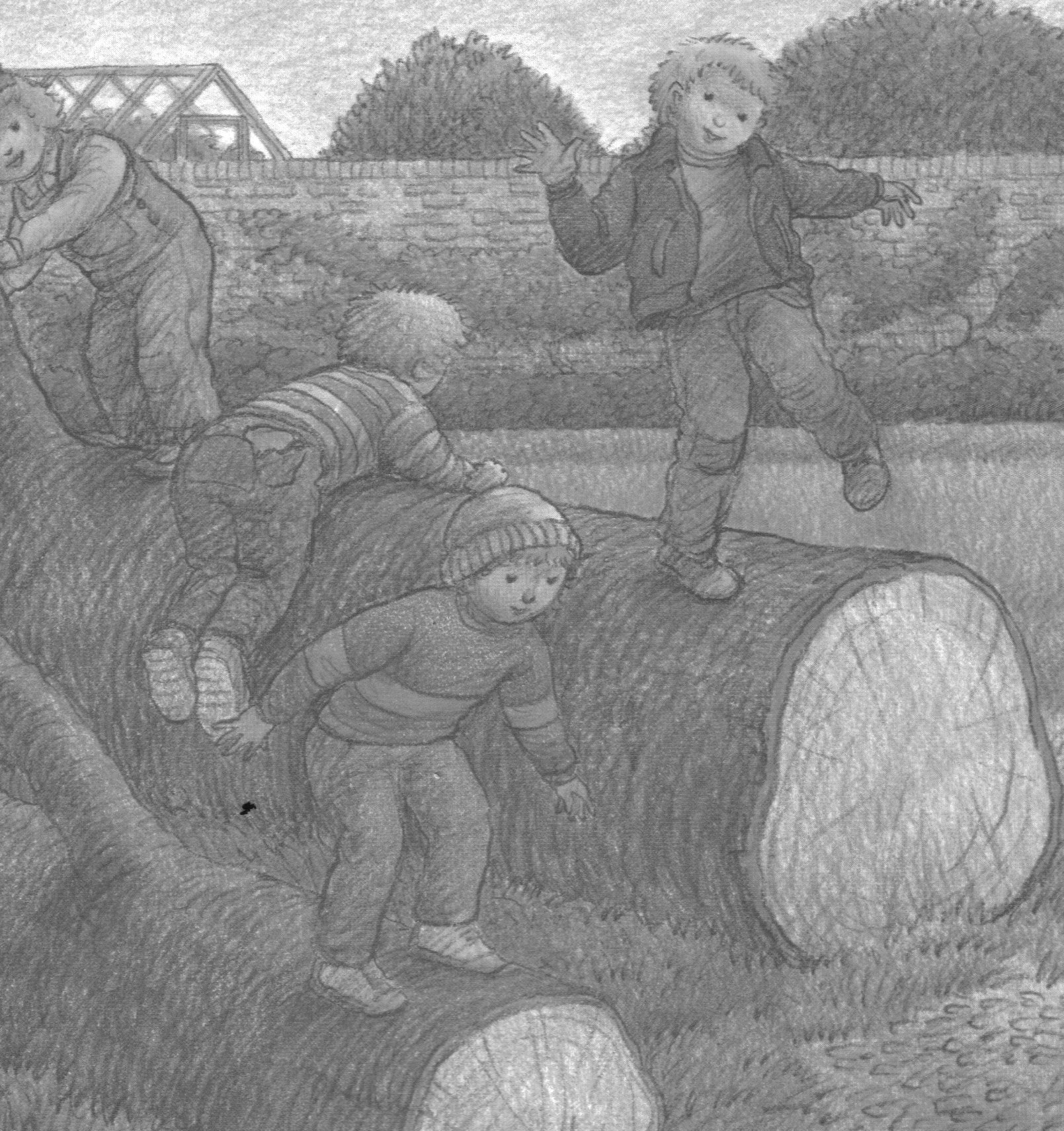
Yes, I am afraid it is true. I am a chain saw killer. I have cut over forty trees on the property and as they lay there on the ground, I feel much as the writer of the story above. A very good big thing will come from their death – a home for me. Some sad things will happen too – the end of a tree that has stood for over forty years. The end of a tree similar to those seen in this week’s Master’s Golf Tournament that lend majesty and beauty to the world. The end of a tree that supports life. Like so many things in this world, there is a balance of beginnings and endings occurring simultaneously.
Amazingly, as the trees lie on the ground, the insects move in as if drawn by some powerful hand. The first ones bore easily through the bark into the “skin” of the tree. It is called the cambium layer. This is a very thin area of tissue that carries the moisture and nutrients from the roots into the tree’s branches and out to the needles. It is relatively soft – it reminds me of bamboo shoots. Fibrous, soft but also stringy. Here is a cross section of a tree:
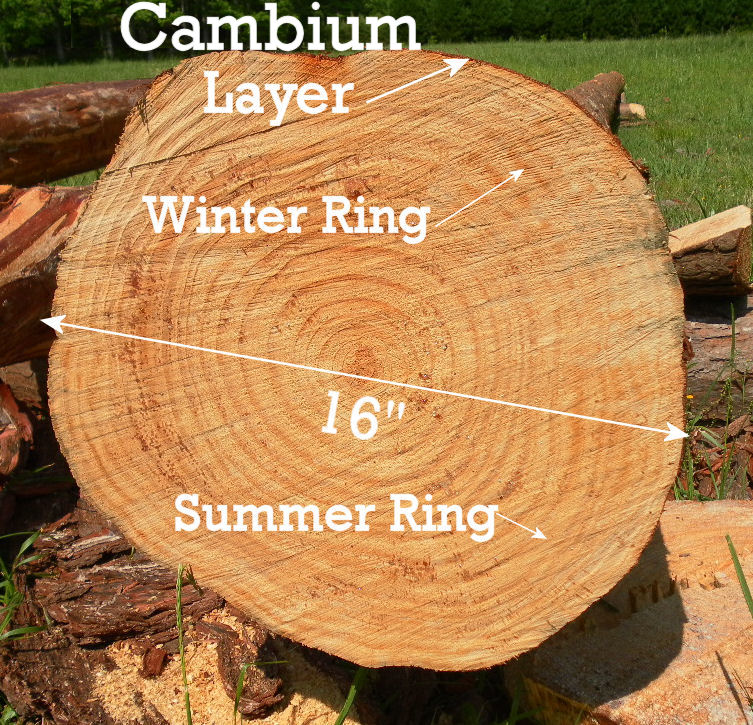
To debark, or “skin”, a tree, one takes a sharpened scraper and slides it between the bark and the cambium layer. Some of the cambium will be scraped off with the bark. The bark must be removed to stop the damage of the insects that bore through it to reach the cambium. It must be feast for these insects. Here is a picture of one:
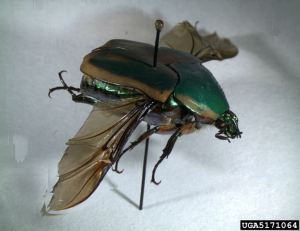
They’re very pretty and can really eat up the cambium layer of the tree. The bark is easier to peel afterward but there are lots of tunnels eaten in the cambium and it probably leaves marks you don’t want on your log wall next to your Picasso, your Michelangelo, or most importantly, your Sarah Irvin.
Next the borers move in. Termites and carpenter ants. They can do some serious damage to the internal structure of the wood. A log is pretty big and I doubt that the termites would really be able to damage it structurally, but they certainly could damage it cosmetically and perhaps their chewing sound would keep you awake at night.
Eventually, a log in the woods would support mold, fungi, worms, etc. as they continued the re-absorption of the log into the “cycle of life”. Since these logs are destined for a bit higher calling than compost, we treat them with an insecticide based on borate.
We used a commercial mixture of borate and glycol called “BorRam”. This soaks into the wood four inches, stopping the borers. I have applied a 5:1 solution of Bor-Ram carefully and generously to all the logs in an attempt to put a permanent halt the cycle of life, stopping the cycle at the log status. Then I can promote them into a “log home” status.
All the logs are raised off the ground with cross sections of “sacrificial” logs. It is not good to allow the logs to be in contact with the ground. As much as possible, keep the logs dry and never in contact with the soil.
I have made one notable mistake on the 21 “wall” logs we currently have. I did not treat them with a “moldicide” (is that even a word?) to prevent mold. Mold they have. How? I wondered. Friday, when I arose, I found out. The ground was so wet from the dew that I thought it had rained. Lying in a valley, below a dam, surrounded by water, the dew is tremendous. Virtually every evening they are covered with dew and in the morning the sun does not dry them until 10:00 so there is lots of time for mold to grow. I’ll get the moldicide in the next batch of Bor-Ram. I was trying to save money and now know it was a “penny saved is a penny earned”.
Wait, that doesn’t make sense. Wrong silly proverb. How about “dear is cheap and cheap is dear”. Yeah, that’s it. So trying to be cheap cost me.
Time for some math. If each log is, on average, 12″ in diameter and a I want to build a wall 8′ high, how many logs do I need for my cabin? If you answered 8, I would say excellent but with one wall, how would I hold up the roof and how would I stay warm when the cold North wind blew? If you said 16, you are very confused. 32? Getting closer. Certainly 32 for just the walls but then we have to support the roof. Add another four logs for that – three going up and down through the whole height of the cabin (called Ridge Pole Support Logs or RPSL) and, of course, finally, the grandest log of them all, the RIDGE POLE. It runs horizontally the length of the house, is supported by the RPSLs and it holds up the roof. You will see it when you look at the ceiling inside the cabin.
So class, how many logs? 36? Excellent. Except you need more. You need four more temporary logs vertically raised in each corner to lift the wall logs into place. These logs have pulleys on the top of them and using leverage, just one person could hoist the logs into place. Of course it would take a really, really long time but it could be done. So that is another 4 logs. What is our total so far? 40? Good.
But wait, we already mentioned some logs lying on the ground to support the other logs and to help keep them dry. Add another 8 – 10 logs. Gee, the count is really getting up there. 50 logs. Hmm. that should do it. About 50.
We have 20 wall logs, 1 ridge pole candidate and about 8 “keep the logs off the ground logs (KTLOTGL?). The final question of your math exercise – how many logs do we still need?
I really don’t know either but it is about twenty. A thorough survey of all the property identified another 15 -20 candidates but they were not the “high cotton” category (“high cotton” refers to the cotton that is easy to pick). They are the “low, backbreaking, ‘are you kidding me?'” type of cotton. Three of them actually have grown right around a barbed wire fence. Nasty job. Barbed wire and chain saws do not get along.
They are surrounded by other trees so when they fall the other trees will most likely catch them in their branches. A “hung tree” is nicknamed a “widow maker”. They really are that dangerous.
They get hung easily because, in a sense, their tops don’t weigh much when they are almost vertical. All their weight is directed straight down and most of this is supported by the trunk. As they fall more and more into a horizontal position, their weight is less and less supported by the trunk and more and more supported by anything it the way. A small tree receiving the last bit of a large tree’s fall will be crushed. The same tree, close to the cut tree, may stop its fall almost before it starts. Then you get a hung tree.
They are also on remote parts of the property, difficult to access. I have already widened a couple of trails so a truck can get back there but there is still a lot of preparatory work to get those trees out.
One morning as I was working outside, I heard some heavy machinery. Not chain saws but something that sounded like a road crew clearing underbrush. Pretty loud but I thought it would pass by as they worked their way down the highway. It didn’t pass. Buzz, buzz, buzz, rumble, rumble.
As I headed up the hill into town that morning, I saw a small temporary sign by the side of the road that said “Logging Trucks”. Curious, as I continued up the road, I looked to my left at my ‘one door removed up the road’ neighbor’s property and I saw loggers clearing their land! Wow, how great is that? Maybe I can buy some logs, drag them down the hill and get my additional 20.
I approached my neighbors. Lots of discussion, lots of decision makers, lots of confusion, lots of delay, lots of patience on my part, lots of “visiting” and FINALLY, I was able to strike a deal with the logger. I identified 9 trees on my neighbor’s property that would work and tagged them with ribbons. I asked the logger if he wanted a contract and he said no. I am writing one anyway, not for him but for me, because I am still not sure everyone quite understands my request. Just cut them, top them and I will do everything else. Simple.
Glazed looks indicate perhaps incomplete comprehension. I even resorted to pictures and I cannot draw so you know how mightily I was attempting to convey – cut them, top them, I pay you. I do all the additional work.
More good news. The logger felt that he had additional jobs near my property that would provide the balance of the logs we need. Thank you logger.
Thank you God for your beautiful trees.
Cut them, top them,
Frank


 Erywilde
Great post! Bet you didn’t think when you started this project that it would improve your creative writing skills 🙂
The whole blog is very creative, Ward. A true Rennaisance man!
Terry Rogstad